Eye-Tracking Study on Driver Behavior

User Study
collaboration

Volvo Car Corporation,

Smart Eye,

RISE

Project type
User Study
Project Year
2025

Background

This thesis was conducted at Volvo Cars and is part of the larger SCREENS II project, which aims to improve traffic safety by addressing challenges in increasingly automated driving environments. The project supports the Swedish automotive industry with tools, methods, and insights for designing safer and more user-friendly in-vehicle digital experiences. Within this context, this study examined the influence of a Head-Up Display (HUD) in the use case of traffic navigation.

Objective

Building on the SCREENS II project goals, I collaborated with a classmate to design and conduct a real-traffic user study using eye-tracking to capture driver behaviour during navigation. We evaluated how a conventional HUD affects attention, distraction, and cognitive load in realistic driving conditions, assessing both safety and usability. Our work included designing the experimental setup, configuring and calibrating eye-tracking, collecting and preprocessing data, conducting statistical and thematic analyses, and sharing responsibilities for participant recruitment, HUD adjustments, and reporting.

Experimental Design

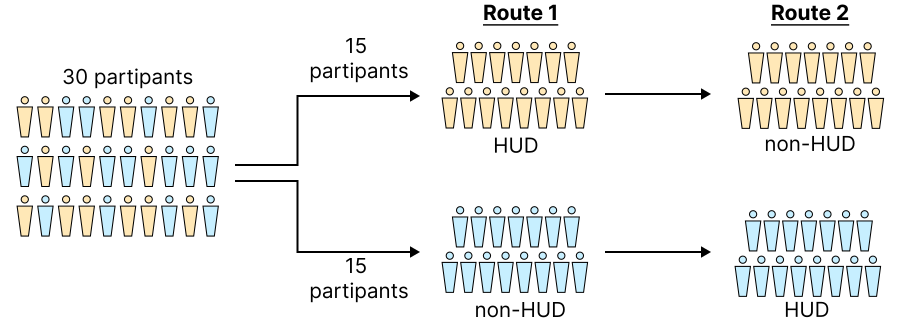
In this within-subjects user study with counterbalancing, drivers experienced two display conditions: HUD and non-HUD. A mixed-methods approach was employed combining quantitative and qualitative data to assess the HUD’s impact on driver performance.

Participants

A power analysis was conducted to determine the required sample size for robust statistical results. Participants were recruited via convenience sampling through company mailing lists and posters. The study involved 30 licensed drivers from varied backgrounds, in addition to 4 participants who took part in a pilot study.

Procedure

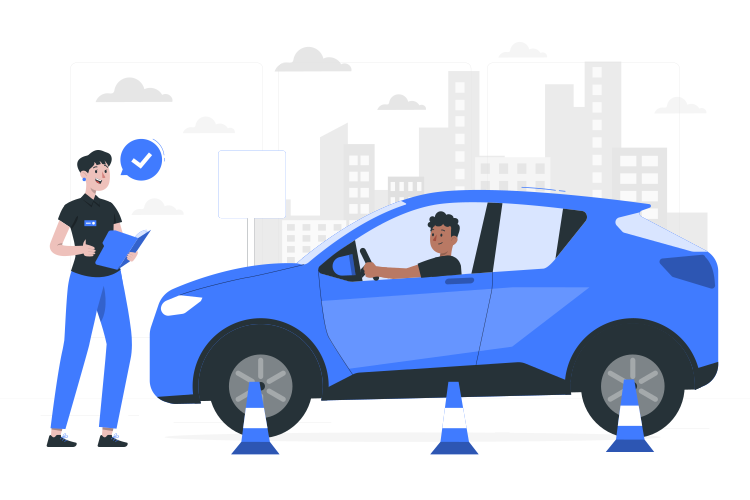
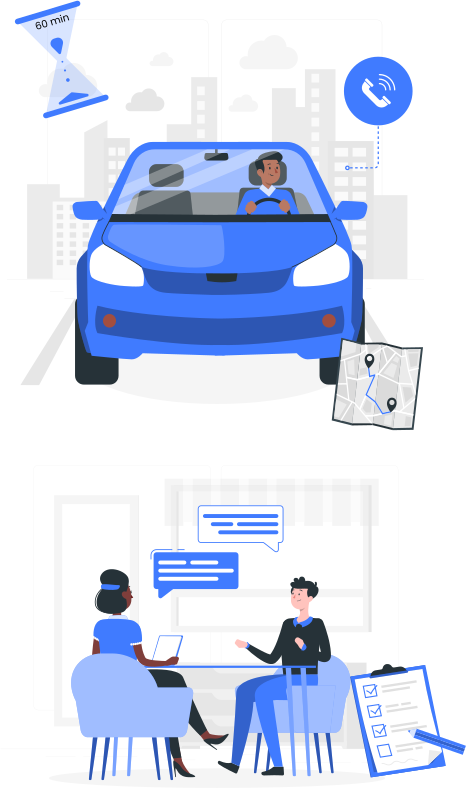
The 60-minute study took place in a Volvo XC60 on real roads under safe daytime conditions. After signing informed consent, participants received brief task instructions to promote naturalistic driving behaviour. They completed two 10-minute routes under HUD and non-HUD conditions, with route order counterbalanced.

Eye-tracking calibration was performed before each route, and participants followed built-in Google Maps navigation, responding to simulated phone calls by declining them. After each drive, participants completed the NASA-TLX workload questionnaire and provided usability feedback in a short interview.

Data Collection

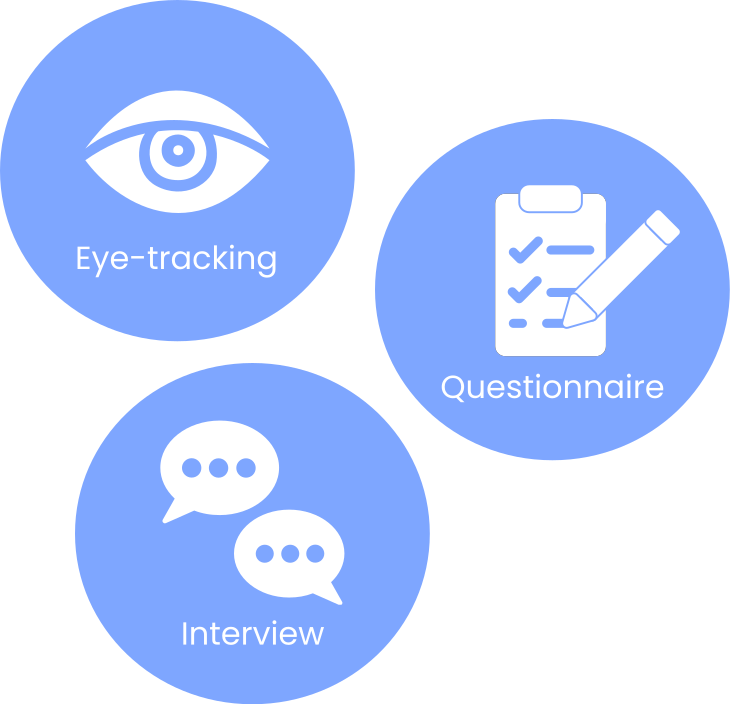
Eye-tracking and NASA-TLX questionnaires were used to measure driver attention, workload, and distraction. Gaze time was tracked across the HUD, other in-vehicle displays, and the road to understand focus and situation awareness. Semi-structured interviews captured participants’ perceptions of HUD usability and safety. Data were analysed both overall and during specific driving events, such as navigation cues, lane changes, and phone calls.

Data Analysis

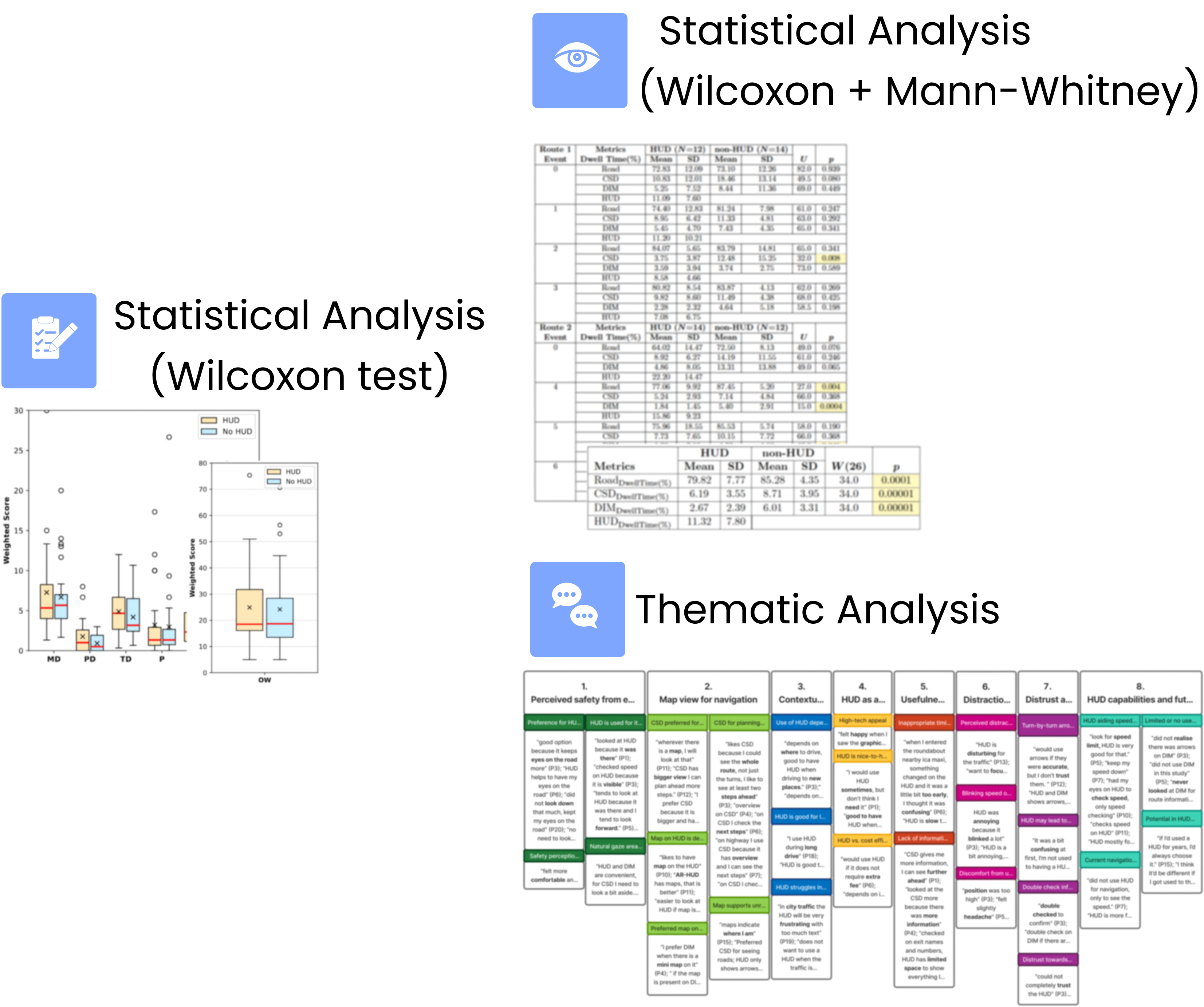
Before analysis, data were checked for outliers and validated to ensure quality. Eye-tracking data were assessed for accuracy and reliability, including time spent on each Area of Interest (AOI). Statistical analysis was performed on eye-tracking metrics and NASA-TLX scores to identify differences between HUD and non-HUD conditions. For qualitative insights, thematic analysis of interview responses was conducted to explore participants’ perceptions of usability and safety.

Findings

The HUD reduced drivers’ need to look at other in-vehicle displays and was generally seen as making driving safer, though some usability concerns arose, especially with the navigation feature. Overall cognitive load did not change significantly, but a few participants reported eye discomfort. These results suggest that well-designed HUDs can improve driving safety, but better interface design and more research are needed to minimise distractions and usability problems.

Thank You

- Other Projects -